 PRIME MOTION
Settings — Probing
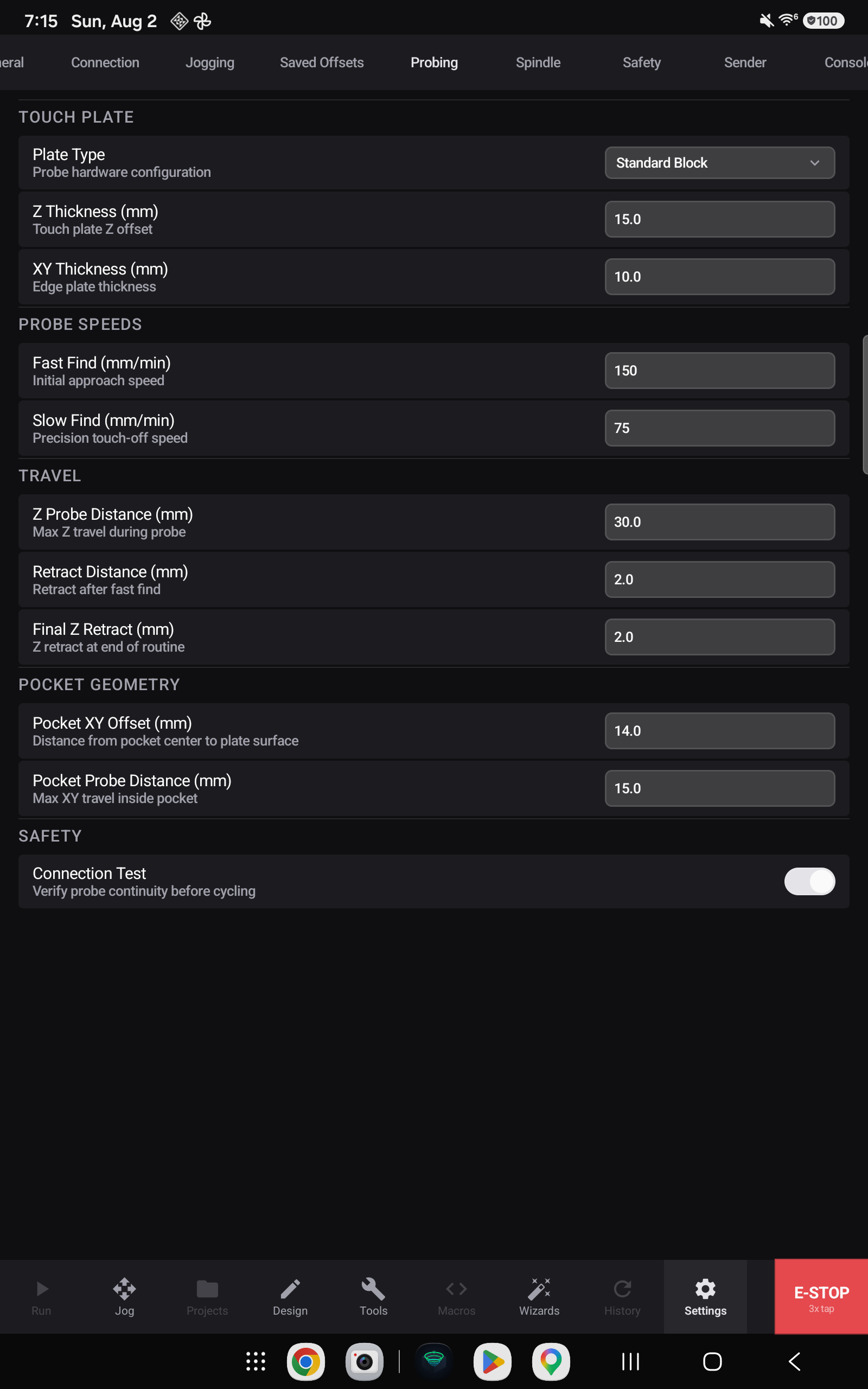
The numbers every probing cycle uses. Get these right once and probing is reliable; get one wrong and it is confidently wrong every time.
Your touch plate
Start here. Choosing your plate is the first thing to do, because it decides everything else: which cycles the Probe panel will offer, which routine runs, and what the drawing above the settings shows.
The picture is not decoration — it is how you check that the app and the object on your bed are the same object. It is drawn from the numbers below, so typing a measurement in changes the picture. If the drawing does not look like your plate, something is wrong before the machine has moved.
Choosing a plate chooses its routine. Stroke order, probe directions, the retracts and the drop down the outside of the plate are not settings — they are what moves the machine, and they belong to the plate's shape. What you can change is every measurement.
The measurements
Only the ones your plate's shape actually uses are shown. A bore diameter is not a blank on an L-shaped block; it is a question that does not apply, so it is not asked.
Z stand-off, corner cycle and Z stand-off, Z-only cycle are usually different numbers on the same plate. Hooked on the corner the body rests on the material; laid flat the underside lip does, and the top face sits higher. Measure both.
Wall thickness is the material between the plate's inner face — the one against your stock — and the outer face the tool touches. It goes straight into the X and Y datum.
Unlisted plate? Choose Custom, tell the app which of the three shapes it is and whether it can find X and Y, and type in its measurements. It works from that point on.
Plate facts the app cannot change
Below the picture are things about your plate you may need to act on:
- Probe input — some plates need the controller's probe signal inverted. Getting it wrong does not measure badly; it either never triggers or triggers instantly.
- Conductive stock — some plates must be isolated from the machine and cannot be used directly on metal or on workholding with a path to the frame.
- Tool diameter — some plates need it because it enters the datum; some need it only so the tool fits inside a bore; some do not need it at all.
Speeds
Probing is usually two moves: a fast approach to find the surface roughly, then a slow one to find it precisely.
Fast enough not to waste time, slow enough that the machine stops the instant it makes contact. Slower is more accurate; slower is also the difference between a touch and a dent.
Travel and retract
Maximum probe distance is how far a cycle will travel before giving up. Enough to reach the surface, not so much that a missed contact drives the tool a long way into something.
Retract is how far it backs off after touching.
Edge placement slack applies only to plates that touch an outer face. It is extra travel on the move that takes the tool clear of the plate before it drops down the outside — cover for how far off your jogged starting position may be.